T_TDM: A Tool for The Topology Discover And Manage the Computer Network Via High Level Abstraction
Description
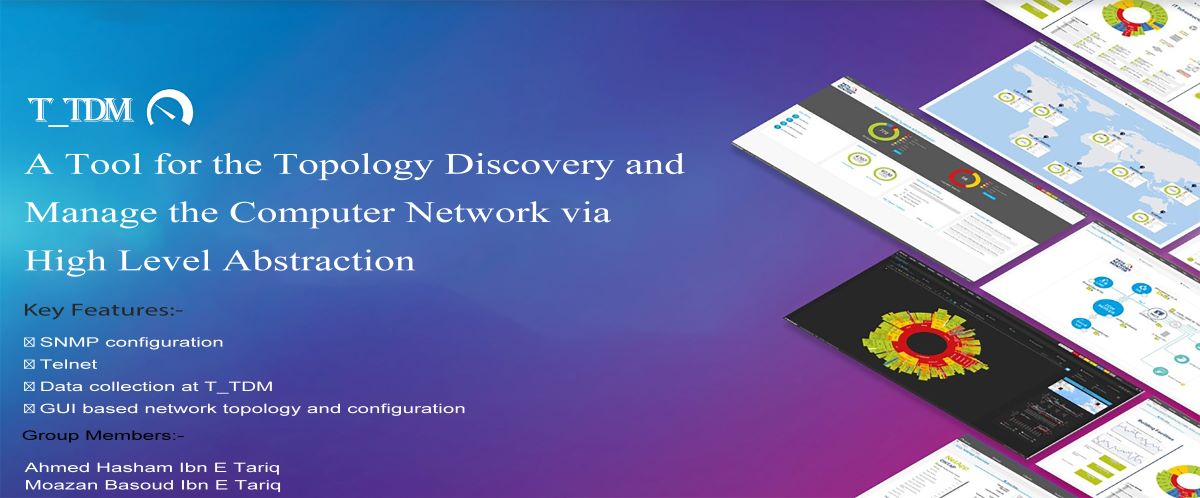
The Tool for the Topology Discover and Manage the Computer Network (T_TDM) is a GUI-based application designed to simplify the monitoring, management, and configuration of computer networks. It provides a high-level abstraction for configuration commands and utilizes various networking APIs and protocols such as SNMP and Telnet.T_TDM offers real-time network configuration display, ensuring that any faults or failures like link failures are promptly detected. This feature allows network administrators to quickly identify and address network problems.The application presents a graphical representation of networking devices, their connectivity, and configuration. It supports auto-discovery of the network. T_TDM caters to various industries and can be accessed locally, providing flexibility and accessibility.Overall, T_TDM aims to enhance network management efficiency, improve fault detection and resolution, and provide a user-friendly experience for network administrators.
Objectives
The objective of the T_TDM system is to provide a comprehensive and user-friendly tool for discovering, managing, and configuring computer networks. The system aims to simplify network administration tasks and improve the efficiency and effectiveness of network management processes. The key objectives of the system are as follows: Real-time Network Monitoring: T_TDM will continuously monitor the network and provide real-time updates on the network configuration. It will detect faults, such as link failures or connectivity issues, and promptly alert the network administrator. GUI-Based Network Visualization: The system will feature a graphical user interface (GUI) that presents an intuitive and visual representation. Administrators can easily view and navigate through the network, visualize the connectivity between devices, and understand the overall network structure. The GUI will provide a user-friendly interface for accessing and managing network devices. High-Level Abstractions for Configuration: T_TDM will offer high-level abstractions for common configuration tasks, such as IP address configuration and ACL policies. These abstractions will simplify the configuration process by providing an intuitive interface and reducing the reliance on low-level networking commands. Administrators without extensive networking knowledge can easily configure and manage network devices. Integration of Networking APIs and Protocols: The system will leverage various networking APIs and protocols, including SNMP, Telnet, and others, to interact with network devices. It will utilize these APIs to gather device information, retrieve configuration details, and perform management tasks. This integration will enable seamless communication with different types of networking devices in the network. Fault Highlighting and Performance Monitoring: T_TDM will highlight network faults through visual indicators and provide. Administrators will be able to quickly identify and address issues, ensuring minimal downtime and efficient network operation. The system will also provide performance monitoring capabilities to track the availability and performance of networking devices. Open Source and Industry-Agnostic: T_TDM will be an open-source tool, making it accessible to a wide range of users. It will be designed to be industry-agnostic, suitable for use in various sectors such as education, healthcare, finance, and more. The system will be easily customizable and adaptable to different network environments and requirements. By achieving these objectives, T_TDM aims to empower network administrators with a powerful and intuitive tool for network discovery, management, and configuration. It will enhance the efficiency, reliability, and performance of computer networks while reducing the complexity and effort required for network administration tasks.
Socio-economic benefit
The T_TDM system is expected to bring several socio-economic benefits by improving the management and efficiency of computer networks. Some of the potential benefits include: Enhanced Network Performance: By providing real-time monitoring, fault detection, and performance monitoring capabilities, T_TDM can help optimize network performance. It enables network administrators to quickly identify and address issues, reducing downtime and improving overall network reliability. This, in turn, leads to improved productivity and operational efficiency for businesses and organizations relying on computer networks. Cost Savings: The efficient management of computer networks through T_TDM can lead to cost savings. By promptly identifying network faults and addressing them, businesses can avoid prolonged downtime that can result in financial losses. The system's automation features, such as auto-discovery, also reduce the need for manual network configuration and maintenance, saving time and labor costs. Increased Productivity: T_TDM simplifies network administration tasks by providing a user-friendly GUI and high-level abstractions for configuration commands. This allows network administrators to perform their duties more efficiently, saving time and effort. With enhanced network monitoring and fault detection, administrators can proactively address issues, minimizing disruptions and enabling employees to work without interruptions, thereby improving overall productivity. Improved Decision-Making: The comprehensive network visualization provided by T_TDM enables better decision-making for network administrators and IT teams. With a clear understanding of the network topology and connectivity, administrators can make informed decisions about network upgrades, expansions, and security measures. This leads to optimized resource allocation, improved network planning, and enhanced strategic decision-making. Accessibility and Flexibility: T_TDM being an open-source tool ensures accessibility for a wide range of users, including small businesses, educational institutions, and non-profit organizations with limited budgets. The system's industry-agnostic design allows it to be adapted to various network environments, accommodating the needs of different sectors. Its flexibility makes it accessible to organizations across different socio-economic backgrounds, democratizing access to efficient network management tools. Skill Development: By providing high-level abstractions for network configuration tasks, T_TDM can contribute to skill development among network administrators. It reduces the need for in-depth knowledge of low-level networking commands, making network management more accessible to individuals with varying levels of expertise. As a result, administrators can focus on higher-level tasks and expand their skill set in areas such as network optimization, security, and performance tuning.
Methodologies
The development and implementation of the T_TDM system can utilize various methodologies to ensure its success. Here are some commonly used methodologies that can be applied to this project: Agile Methodology: Agile methodologies, such as Scrum or Kanban, can be employed to manage the development process iteratively and incrementally. This approach allows for flexibility and adaptability, as the project requirements and priorities can evolve over time. It involves breaking down the development into smaller sprints or iterations, with regular feedback and collaboration with stakeholders. The project team can continuously deliver working software and gather feedback to make necessary adjustments and improvements. Waterfall Methodology: The waterfall methodology follows a linear sequential approach, where each phase of the project (requirements gathering, design, development, testing, deployment) is completed before moving to the next phase. This methodology is suitable when the project requirements are well-defined and unlikely to change significantly throughout the project duration. It provides a clear structure and allows for a systematic approach to development, ensuring that each phase is completed before progressing to the next. Prototype Methodology: In this methodology, a prototype of the system is developed early in the project to gather feedback and validate requirements. This allows stakeholders to visualize and interact with the system at an early stage, enabling iterative refinements and improvements based on their feedback. It is particularly useful when there is a need for active involvement and validation from end-users. The prototype serves as a basis for further development and helps ensure that the final system meets the stakeholders' expectations. Spiral Methodology: The spiral methodology combines elements of both waterfall and iterative development. It involves iterative cycles, where each cycle goes through phases of requirements gathering, design, development, and testing. The spiral approach allows for risk analysis and mitigation at each iteration, ensuring that potential issues are identified and addressed early in the project. It is suitable when there are uncertainties or risks involved in the project, and regular evaluation and feedback are necessary to make informed decisions. DevOps Methodology: DevOps is a methodology that emphasizes collaboration and integration between development and operations teams. It focuses on automating processes, continuous integration, and continuous delivery to ensure efficient software development, deployment, and maintenance. Adopting DevOps practices can help streamline the development and deployment of the T_TDM system while ensuring reliability and scalability. It promotes collaboration and communication between teams, enabling faster feedback loops and reducing the time to market.
Outcome
The T_TDM project aims to achieve several outcomes that will contribute to the effective management and optimization of computer networks. The expected outcomes of the project include: Efficient Network Discovery: The T_TDM system will provide automated discovery capabilities, enabling administrators to easily identify network devices. which facilitates efficient network management and troubleshooting. Real-time Network Monitoring: With T_TDM, administrators will have access to real-time network monitoring and fault detection. The system will promptly alert administrators about network issues such as link failures or connectivity problems. This outcome ensures quick response and minimizes network downtime. User-friendly GUI Interface: The project will result in a graphical user interface (GUI) that simplifies network device management and configuration. The GUI will offer intuitive controls and visual representations of network devices, connectivity, and configuration. The outcome will be an accessible and user-friendly tool for network administrators. High-Level Abstractions for Configuration: T_TDM will provide high-level abstractions for common network configuration tasks, such as IP address configuration and ACL policies. This outcome simplifies the configuration process, reduces the dependency on low-level commands, and enables administrators with varying levels of expertise to efficiently configure network devices. Integration of Networking APIs and Protocols: The project will integrate various networking APIs and protocols, such as SNMP and Telnet, to interact with network devices. This outcome ensures seamless communication and compatibility with a wide range of networking equipment, enabling administrators to manage diverse network environments. Open-Source and Industry-Agnostic Solution: The project outcome will be an open-source T_TDM tool, accessible to a broad user base. It will be adaptable to various industries and sectors, allowing organizations from different domains to benefit from its features. This outcome promotes collaboration, knowledge sharing, and community-driven improvements. Streamlined Network Administration: The T_TDM system aims to simplify network administration tasks, leading to increased efficiency and productivity. By automating certain processes, providing a user-friendly interface, and offering high-level abstractions, the project outcome will empower network administrators to manage and configure network devices more effectively. Overall, the project outcome of T_TDM is to provide a comprehensive and user-friendly tool that simplifies network discovery, management, and configuration. The expected outcomes include efficient network discovery, real-time monitoring, user-friendly GUI, high-level abstractions, integration with networking protocols, open-source accessibility, and streamlined network administration. These outcomes collectively contribute to enhanced network performance, reduced downtime.
Gallery



More from Computer Science

Automation System for Ayaz Memorial Hospital
Automation System for Ayaz Memorial Hospital is a web-based system that is designed to streamline and improve…
Supervisor: Mr. Mian Muhammad Talha

CarGo
The cargo app eases People who are working far from home and travel daily on local transport.This application…
Supervisor: Samia Zafar

Projectorate - A software project management and collaboration platform
Projectorate is a comprehensive software project management and collaboration platform designed to streamline…
Supervisor: Dr. Mudassar Raza

Victorious Flick Prevision
We are making a prediction system using data mining that will help people from the film industry to focus on m…
Supervisor: Taimur Sajjad