SentiVision - "Seeing Beyond, Securing the Present"
Description
SentiVision is an intelligent software system designed to control a mobile robotic platform for advanced object detection, interaction, and navigation. By integrating computer vision algorithms with hardware components, such as a camera, laser pointer, and servo motors, SentiVision enables realtime visual data processing for precise object detection and localization. Through a user-friendly interface, operators can monitor the robot’s environment, detect anomalies, and control the laser pointer for accurate targeting of identified objects. Additionally, the system autonomously detects and avoids obstacles, enhancing its navigation capabilities. With API support for integration into external security and emergency systems, SentiVision offers a versatile solution for intelligent surveillance, accessibility, and operational efficiency, making it ideal for applications in security, assistance for individuals with disabilities, and emergency response.
Objectives
Develop a Prototype System: Establish a customizable and adaptable prototype capable of object detection tailored for specific applications, such as accessibility, security, and search and rescue. Enhance Accessibility: Provide real-time visual assistance for individuals with disabilities, enabling them to navigate confidently and independently. Improve Security: Strengthen surveillance systems by detecting anomalies, including predefined classes like animals and weapons, and monitoring restricted areas in real-time. Optimize Search and Rescue Operations: Assist rescue teams by identifying victims and assessing hazards using adaptable detection capabilities. Facilitate Customization: Enable users to add domain-specific object classes and behaviors to enhance system adaptability. Seamless Hardware Integration: Ensure efficient operation through integration with hardware components, such as Jetson Nano and Arduino.
Socio-economic benefit
Improving Quality of Life for Individuals with Disabilities: By providing real-time visual assistance, SentiVision empowers individuals with disabilities to navigate safely and independently, fostering inclusivity and equal opportunities. Strengthening Public Safety and Security: SentiVision aids in monitoring restricted areas, detecting potential threats (e.g., weapons or anomalies), and ensuring proactive responses, reducing risks in public and private spaces. Supporting Emergency Response Efforts: In search and rescue scenarios, SentiVision enhances efficiency by identifying victims and assessing hazardous conditions, potentially saving lives and minimizing risks to rescue teams. Customizability for Diverse Applications: As a prototype, SentiVision offers flexibility to address specific socio-economic needs across industries like healthcare, surveillance, and disaster response, encouraging innovation and investment in safety technologies. Encouraging Technological Advancement: By integrating cutting-edge robotics and vision technologies, the project contributes to advancements in AI-based safety systems, inspiring future developments and job creation in high-tech fields.
Methodologies
Prototype Development: Build and refine a working prototype using Jetson Nano, Arduino, and a stereo camera for real-time detection and analysis. Focus on pre-defined object classes to validate functionality while keeping the system adaptable for future needs. Algorithm Design and Training: Employ deep learning techniques for accurate object recognition and classification, emphasizing adaptability and scalability. Utilize real-world datasets to train models, optimizing them for speed and accuracy within the prototype’s constraints. Hardware-Software Integration: Seamlessly integrate hardware components to ensure real-time processing and low latency, suitable for practical applications. Optimize resource utilization to achieve maximum efficiency on limited hardware. User-Centric Design: Develop intuitive interfaces for interaction and decision-making, prioritizing accessibility for users with disabilities. Incorporate customizable features to address specific user or domain requirements. Testing and Validation: Conduct rigorous testing under various scenarios to ensure reliability, robustness, and adaptability. Collect user feedback to iterate and improve the prototype.
Outcome
Functional Prototype: Deliver a working prototype that demonstrates real-time detection of 9 object classes, adaptable to meet specific needs in accessibility, security, and search and rescue. Proof of Concept: Validate the feasibility of integrating robotics, computer vision, and human-computer interaction in a cohesive, real-time system. Improved Accessibility: Showcase the system’s capability to assist individuals with disabilities, providing them with enhanced independence and mobility. Enhanced Security and Surveillance: Present the potential of the prototype to detect threats, monitor restricted areas, and aid in proactive decision-making. Future Scalability: Highlight the system’s flexibility for future customization, additional classes, and domain-specific adaptations, paving the way for broader applications. Technology Demonstration: Establish SentiVision as a foundation for future innovations in AI-driven assistive and safety systems.
Gallery


More from Computer Science

Career Bridge: Connect students and alumni for guidance and boosting their careers.
Career Bridge bridges the collaboration gap between university students/freelancers and alumni. Through our pl…
Supervisor: Beenish Noor
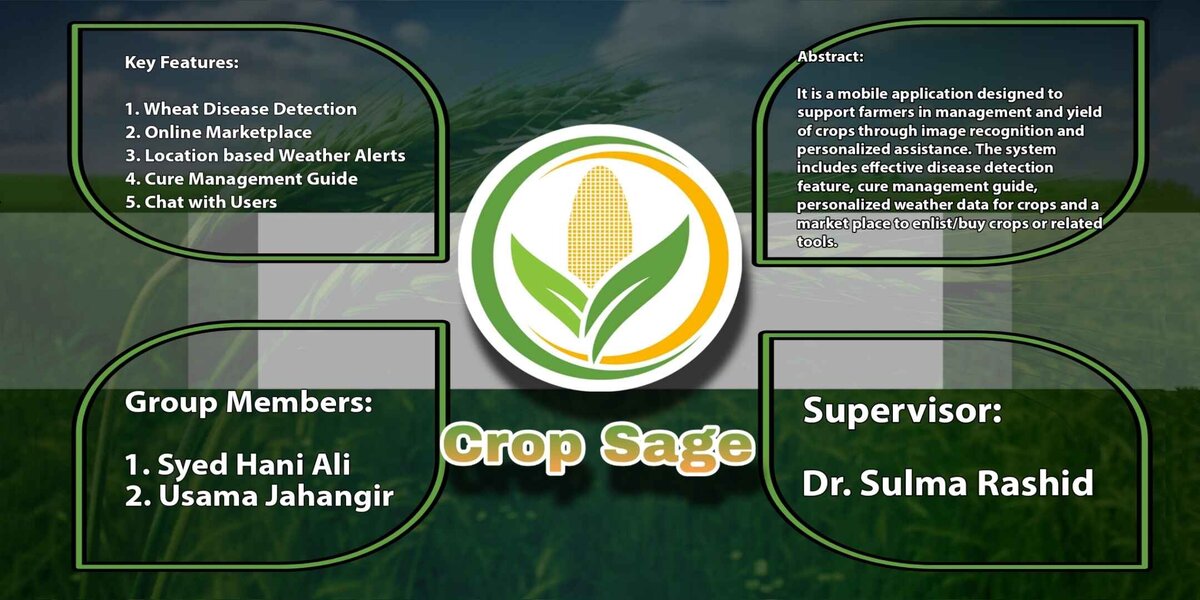
CropSage - Smart Wheat Management Mobile App
The CropSage System is an innovative mobile application designed to support wheat farmers by offering a compre…
Supervisor: Dr. Sulma Rashid

Zaplead Sales Copilot
Zaplead’s AI-powered assistant revolutionizes the way you approach sales. By streamlining time-consuming proce…
Supervisor: Dr. Faisal Shafique Butt
MediChaos
MediChaos is a modern Hospital Management System built with the MERN stack to streamline healthcare operations…
Supervisor: Dr. Sheraz Anjum