Smart communication device for blind (SOVERN)
Description
This project is a smart assistive device designed for the visually impaired, leveraging Raspberry Pi 4, Pi Camera, and AI-based object detection (MobileNetSSD). It identifies objects like bottles, people, and chairs,car along with detecting light sources, and conveys this information via real-time voice alerts using the espeak TTS engine. The system enhances spatial awareness and navigation through low-cost, open-source hardware and software, ensuring accessibility and independence for blind users.
Objectives
The main objective of this project is to develop an assistive communication device for visually impaired individuals that can detect objects and environmental light sources in real time and provide auditory feedback to help them navigate their surroundings. This device aims to: Enhance the situational awareness of blind individuals using computer vision. Provide a low-cost, portable solution using Raspberry Pi 4. Enable real-time detection of commonly encountered objects such as people, chairs, bottles, and lights. Convert the visual information into speech output using a text-to-speech engine. Offer guidance by indicating the position of detected objects (left, center, or right).
Socio-economic benefit
This device holds significant socio-economic benefits: Accessibility: It provides a low-cost solution for blind individuals, making assistive technology affordable and available, especially in low-income or rural areas where high-end alternatives may not be accessible. Independence: Visually impaired users can navigate indoor environments more safely and confidently without constant human guidance, increasing their autonomy. Employment Opportunities: By enhancing confidence and reducing dependence, users can more actively engage in education, work, and social settings, improving their economic prospects. Healthcare Savings: Reducing accidents or navigation-related injuries among the blind can decrease the burden on healthcare systems. Open Source & Scalable: Since the system is built on open-source hardware/software, it can be replicated, improved, or customized without additional licensing costs, supporting local innovation and community-driven improvements. Educational Value: The project can serve as a foundation for further academic research, teaching modules, and hands-on training in embedded systems, AI, and assistive tech.
Methodologies
The device follows the following methodology: Video Capture: A PiCamera module captures real-time video frames and passes them to the Raspberry Pi. Object Detection: Uses the MobileNetSSD deep learning model with a pre-trained Caffe framework to identify objects like bottles, people, and chairs. Object positions are calculated based on bounding box coordinates (left, center, or right). Speech Output: Detected objects and their positions are converted to speech using the espeak text-to-speech engine. Real-Time Feedback: Feedback is updated every few frames to avoid lag while maintaining real-time processing. Optimization: Detection frequency and frame processing are optimized for speed and efficiency using multithreading.
Outcome
The project successfully delivers a real-time, voice-based navigation aid for visually impaired users. Key outcomes include: Accurate detection of common indoor objects and light sources. Clear auditory descriptions of object types and positions in real time. A functional and portable prototype built with affordable components. Demonstrated improved mobility and awareness for users during testing. Potential to expand and integrate GPS, obstacle detection, or voice commands in future versions. Provides a foundation for scalable and customizable assistive technologies tailored to individual needs.
Gallery

More from Electrical Engineering
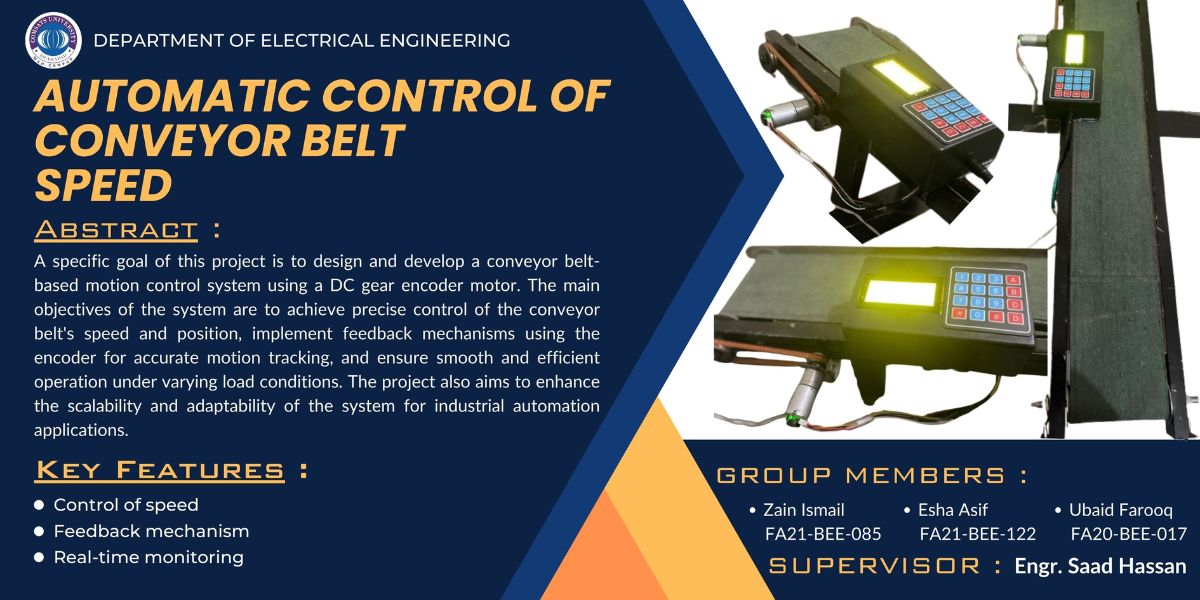
AUTOMATIC CONTROL OF CONVEYOR BELT SPEED
Automatic Control of Conveyor Belt Speed involves a control system (like a microcontroller etc) to monitor var…
Supervisor: Engr. Saad Hassan

Designing a Protection System for Ungrounded Residential HouseHold Appliances
This project focuses on the design and implementation of a cost-effective residential electrical protection sy…
Supervisor: Dr.Sadiq Ahmad

Sensors based Remote Monitoring System for Power lines
This project presents a sensor-based remote monitoring system for power lines, designed to enhance the reliabi…
Supervisor: Engr.Belawal Behram

Solar-Powered Self-Regulating Greenhouse Ecosystem
This project presents a solar-powered self-regulating greenhouse ecosystem designed to automate climate contro…
Supervisor: Dr. Muhammad Iqbal