Experiment and manufacturing of low speed blended wing body
Description
In order to lower fuel consumption and increase aerodynamic parameters, a new concept of blended wing is used. We designed our own model of Blended wing aircraft. Its wind tunnel testing is done plus simulations are performed. The results are compared to each other.
Objectives
Following are the objectives of this project: • To perform subsonic speed analysis at different angle of attacks and varying air velocity, in order to study the corresponding aerodynamic behaviors. • Improvement in the aerodynamic parameters by alterations in wing design. • Reduction of fuel consumption and combustible gases. • To study the glide performance of the blended wing aircraft. • To increase the magnitude of lift and decrease drag magnitude. • To increase passenger capacity.
Socio-economic benefit
This project is based on blended wing aircraft designing and how it can save fuel during flight operation. Hence, if this design is adopted in future aircraft, this will help in less fuel usage and ultimately will benefit in terms of money as well. Also on the large scale, it can provide a number of ways to become economically stable as we can start manufacturing this for commercial use and start exporting it as well . Socially this is an environment friendly air vehicle, hence green engineering is involved in it. The atmospheric emissions are also reduced through this model which is the need of time.
Methodologies
A blended wing consists of two aero foils merged together hence the aero foils we selected were MH78, a reflex aero foil and Selig S1223, an under cambered aero foil giving maximum lift at low speed. Firstly a blended wing model of scale down version was designed on SOLID WORKS and 3D printing was done afterwards. It was investigated inside the subsonic wind tunnel ESSOM ISO 9001 at low speed with different angle of attacks to get different aerodynamic parameters which included the coefficient of lift, coefficient of drag, velocity and pitching moment, pressure points and wake regions. After the wind tunnel testing, its computational fluid dynamic analysis was performed on ANSYS WORKBENCH at different air velocities for getting the values of same parameters which were considered in wind tunnel experiments. Next a full scale prototype model was designed with proper mathematical calculations. This prototype included all parts of blended wing aircraft which included elevon, winglets, propeller, and servo motors with material selection as deferon and this was a radio controlled aircraft whose flight test was performed afterwards via the use of hand-held radio transmitter.
Outcome
The ultimate goal of this project is to increase the efficiency of future aircraft and lower fuel consumption. Hence our objective is achieved and maximum lift is generated which ultimately helps in reducing the drag coefficient. This is done by proving experimentally but also via the help of software’s simulations. The prototype free flight testing has also been done. After comparison between experimental and simulation results, we are successful in achieving the desired outcome.
Gallery


More from Mechanical Engineering
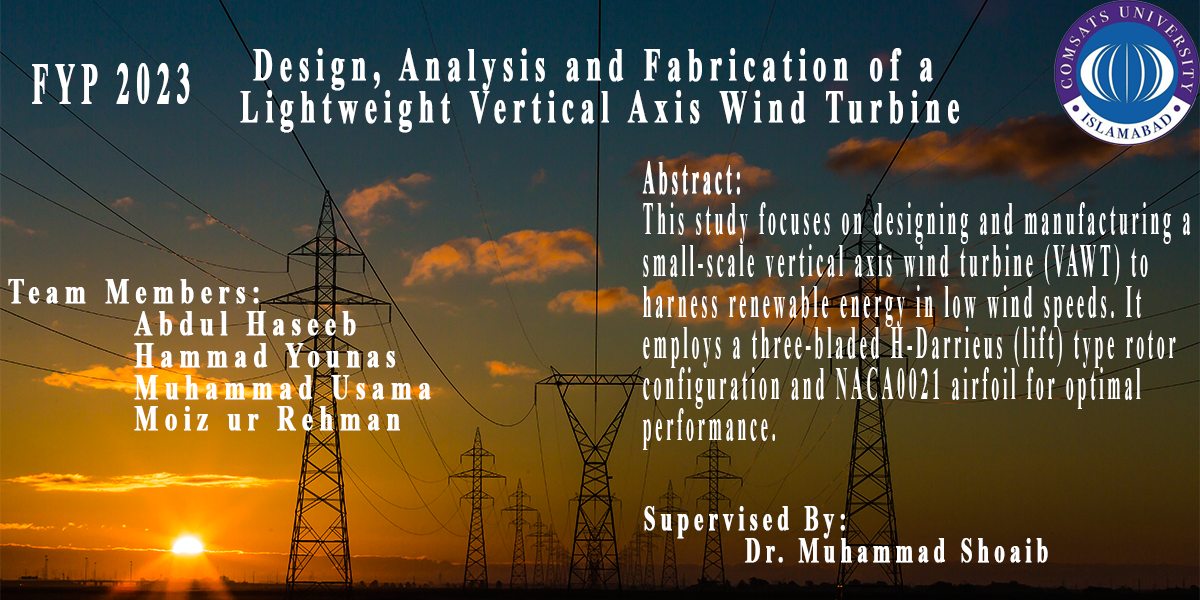
Design, Fabrication and Analysis of a Vertical Axis Wind Turbine
It is small scale and lightweight vertical axis wind turbine (V.A.W.T) use for small applications of electrici…
Supervisor: Dr. Shoaib Naseem
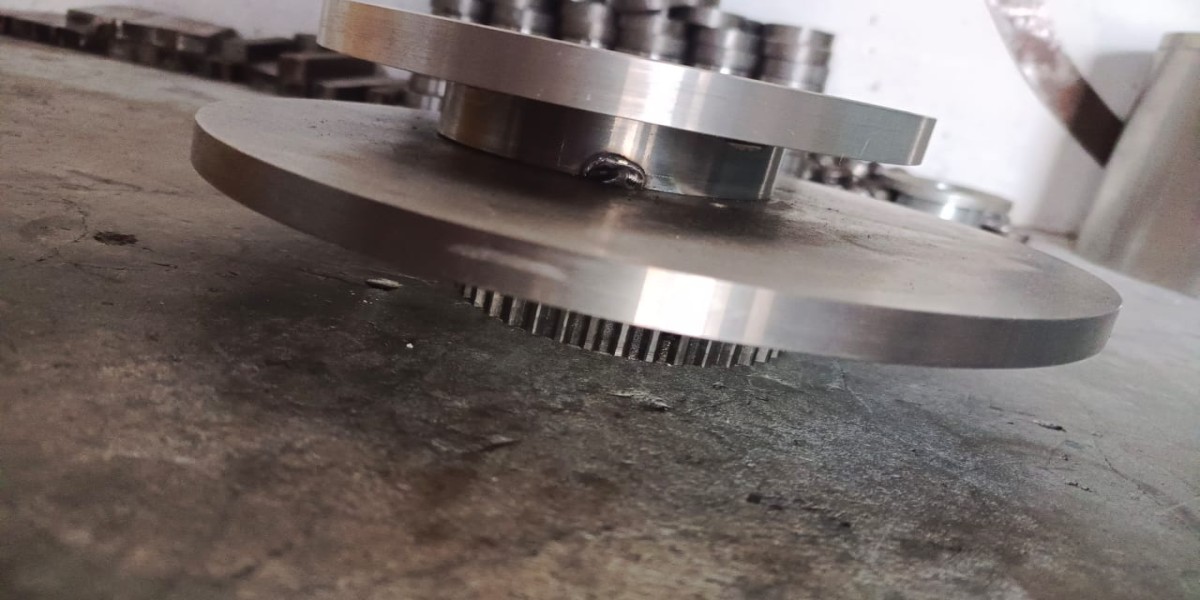
Design and Fabrication of High Energy Ball Mill for the Synthesis of Nanoparticles.
The "Design and Fabrication of High Energy Ball Mill for Nanoparticles Synthesis" project aims to develop an i…
Supervisor: Dr. Muhammad Shoaib Naseem

Development of linear reciprocating tribotester and investigation of nanoparticle-based im…
The project focuses on exploring the potential of mustard oil as a bio-lubricant, considering the increasing i…
Supervisor: Dr. Arslan Ahmed

Synthesis of Synthetic Rubber
This project demonstrate that we developed a prototype on which our aim is to make butadiene by the use of eth…
Supervisor: Prof. Dr. Shoaib Naseem.