Review Management System (RMS) (Version 4.0) is the extension of the existing RMS(Version3.0). In version 4.0, we have to evaluate the project management technique in which student can meet the deadline of their ongoing and upcoming task of FYP project. As matter of fact, we can also find the trend of technologies which students can used for FYP.
Objectives
Objectives of RMS (Version 4.0) are:
? Provided all proposal-related elements and overviews into a comprehensive module, empowering
coordinator to seamlessly incorporate project streams, along with associated tools, domains, and
other pertinent details.
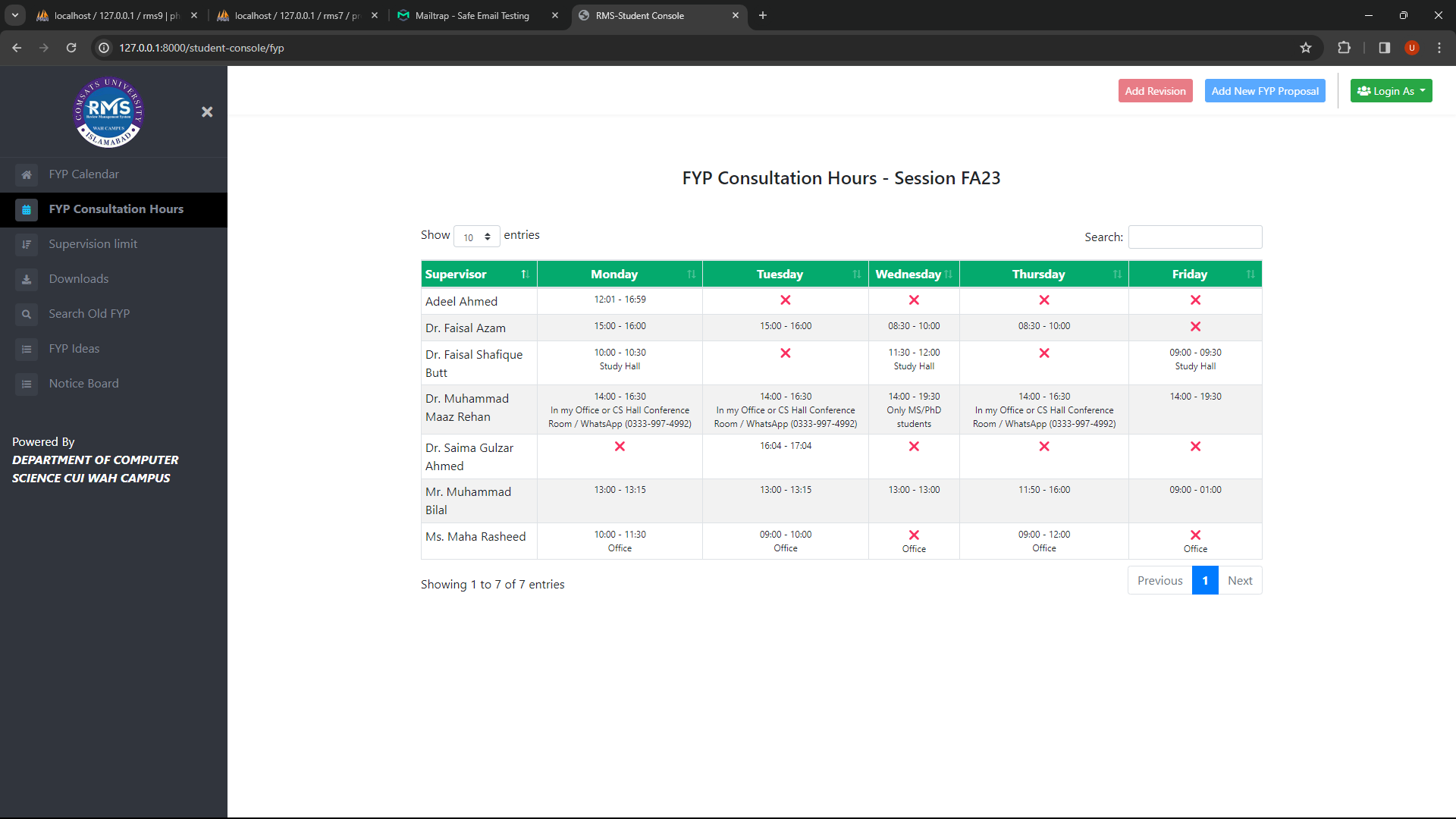
? Implementation of a system to manage and optimize consultation hours for students working on
their Final Year Projects (FYP). The Consultation Hours Module enables supervisors to establish
their consultation schedules, specifying both time and venue. Simultaneously, students can
conveniently check the availability of their supervisors' hours through the student console.
? Within the FYP Ideas Module, supervisors are granted the capability to publish their project
concepts, providing students with the opportunity to volunteer for projects aligned with their
interests. Students can then select and undertake these projects for their Final Year Projects (FYPs).
? Integration of a module to facilitate the process of drafting and submitting industrial letters for
project collaborations.
? Implementation of the NLP Module, an advanced system which utilizes Natural Language
Processing (NLP) to assess proposals on a contextual basis, determining whether similar
proposals already exist within the system.
? Enhancements to address issues related to supervisor shifts.
? Remaking the Internal/External Evaluation module to allow coordinator to change marking
criteria.
? Development of a statistical tracking system to monitor the burden of evaluation team members.
? Sending Emails automatically based on the FYP Calendar to keep supervisors informed about
upcoming deadlines.
? Development of an evaluation criteria CRUD to allow coordinator to change marking criteria for
each session.
? Overhauling the Create, Read, Update, Delete (CRUD) functionalities and selection process for
external examiners to enhance efficiency
Socio-Economic Benefit
Reduction in Paper Usage: Moving to a digital platform reduces the need for physical paperwork, saving resources and contributing to environmental sustainability.
Streamlined Processes: Automated workflows and centralized documentation lead to more efficient FYP management, reducing administrative burdens and saving time for both students and faculty.
Improved Student-Supervisor Interaction: Digital platforms facilitate seamless communication between students and supervisors, fostering better collaboration and mentoring throughout the FYP duration.
Feedback Loop: Instant feedback from evaluators allows students to make timely improvements, enhancing the learning experience and the quality of the final project.
Remote Accessibility: Students and faculty can access the system from anywhere, promoting inclusivity and allowing collaboration among individuals regardless of their physical location.
Resource Sharing: The system can serve as a centralized repository for resources, making it easier for students to access relevant materials and references.
Analytics and Reporting: The system can generate reports and analytics on student performance, providing valuable insights for faculty and institutions to make informed decisions regarding curriculum enhancements and resource allocation.
Consistent Evaluation Standards: A centralized system ensures uniform evaluation criteria, promoting fairness and standardization in the assessment process.
Benchmarking: Historical data and benchmarks can be used to assess the quality of FYPs over time, contributing to continuous improvement in educational programs.
Digital Literacy: Engagement with a digital review system enhances students' digital literacy skills, a crucial aspect in the modern workforce.
Reduced Printing and Distribution Costs: The move to a paperless system reduces costs associated with printing, distributing, and storing physical documentation.
Efficient Resource Allocation: Institutions can allocate resources more efficiently based on data-driven insights, optimizing budget utilization.
Global Collaboration:
Technological Integration: Embracing a digital review management system reflects an institution's commitment to innovation and adaptability to technological advancements in education.
Methodologies
Functional requirement: 01
Provide all proposal-related elements and overviews into a
comprehensive module, empowering coordinators to
seamlessly incorporate project streams, along with associated
tools, domains, and other pertinent details.
• Functional requirement: 02
Implementation of a system to manage and optimize consultation hours
for students working on their Final Year Projects (FYP).
Functional requirement: 03
Supervisors are granted the capability to publish their project concepts
• Functional requirement: 04
Integration of a module to facilitate the process of drafting and submitting
industrial letters for project collaborations
• Functional requirement: 07
Natural Language Processing (NLP) to assess proposals on a contextual
basis
• Functional requirement: 08
Email Notifications when Committee members are reassigned.
• Functional requirement: 09
Proposal Evaluation Committee will be able to check similar projects of
submitted proposal from the RMS previous submitted projects.
• Functional requirement: 10
View FYP Ideas on Student Console.
• Functional requirement: 11
Coordinator can check statistical view of Projects and Students.
• Functional requirement: 12
Coordinator can check the load on possible committee members before
assigning them
• Functional requirement: 13
Supervisors will be Notified before upcoming deadlines.
• Functional requirement: 14
Coordinator will be able to add external examiner in the main database.
• Functional requirement: 15
Students will be able to see submit proposals and revisions in the student console.
• Functional requirement: 16
If a project supervisor is changed, limits are also changed accordingly.
• Functional requirement: 17
Students upload their Report from Student Console. The supervisor does
not have a deadline on the revision or acceptance of report.
• Functional requirement: 18
Coordinator can view and print list of external examiners.
• Functional requirement: 19
Coordinator can make changes to marking criteria and evaluation criteria for each
session.
• Functional requirement: 20
Coordinator cannot add duplicate records instead the student is moved to
current session if duplicate record is added.
Outcome
RMS version 4.0 is well optimized and easy to use as compared to the beta
version of RMS and in this version; we add many features that help our student
and Departmental coordinators to provide more services to FYP students. In
version 4.0, we inform the entire RMS user about his status of their FYP via
emails. Due to this, students are not worried about their submission as well as
coordinators are view the student activities with supervisors.
Version 4.0, optimize all the tables of project that is used to perform various operations
with data and deal with thousands of students data from live server.