Optimization of Turbopump Impeller Design through Artificial Intelligence, Simulation and Experimentation
Description
This project focuses on the optimization of turbopump impeller design using artificial intelligence (AI), simulation tools, and experimental validation. The turbopump impeller, a crucial component in propulsion systems, requires careful design to enhance performance and efficiency, especially at high speeds and pressures. The optimization process involves the application of AI algorithms to identify the best design parameters that will maximize the efficiency and durability of the impeller.Using simulation software such as ANSYS and SolidWorks, different design iterations are tested under various operating conditions. The project will also explore how AI techniques can predict the best geometric and material properties for the impeller, considering factors like cavitation, stress distribution, and fluid dynamics. Additionally, physical experimentation will be conducted to validate the optimized design and assess its performance in real-world conditions.
Objectives
• To design and optimize a turbopump impeller using AI algorithms for performance improvement at low rotational speeds (15,000 RPM) and high pressures (20-25 MPa). • To simulate the optimized impeller design using ANSYS and SolidWorks to evaluate its performance under different conditions, including stress, cavitation, and fluid dynamics. • To conduct physical testing of the optimized impeller using a test rig to validate the design and compare it with traditional designs. • To analyze the effect of different material properties on the turbopump impeller’s performance and efficiency. • To develop a comprehensive methodology integrating AI, simulation, and experimentation to enhance the overall turbopump design process.
Socio-economic benefit
• Improved Turbomachinery Efficiency: The optimized turbopump impeller will contribute to more efficient propulsion systems, reducing energy consumption in aerospace and industrial applications. • Cost Reduction: By using AI and simulations to optimize designs before physical testing, the project reduces the need for costly prototyping and testing. • Technological Advancement: The project will promote advancements in AI-based engineering design, which can be applied to various sectors, including aerospace, automotive, and energy. • Sustainability: The optimization of turbopumps can lead to more energy-efficient systems, contributing to sustainability goals in high-energy industries like aerospace.
Methodologies
• AI-Based Design Optimization: o Use AI techniques (e.g., genetic algorithms, machine learning) to optimize the geometric and material properties of the turbopump impeller. o Implement AI algorithms in conjunction with CAD tools (SolidWorks) to generate design alternatives. • Simulation: o Perform CFD (Computational Fluid Dynamics) simulations using ANSYS to evaluate the flow characteristics, cavitation, and stress distribution in the turbopump impeller. o Conduct FEA (finite element analysis) for structural integrity under high-pressure and high-speed conditions. • Experimental Validation: o Fabricate the optimized impeller design using selected materials. o Set up a testing rig to measure performance under real-world operating conditions, comparing the optimized design with existing ones. • Analysis and Comparison: o Analyze the results of the simulations and physical tests, including flow efficiency, cavitation resistance, and structural integrity. o Identify the most efficient design parameters for future turbopump impeller development. Experimental Setup: The experimental setup will consist of a test rig capable of simulating the operational conditions of a turbopump impeller. Sensors will be used to measure parameters such as temperature, pressure, and vibration, while high-speed cameras will monitor fluid dynamics and cavitation formation. The performance of the impeller will be tested at rotational speeds up to 15,000 RPM and pressures between 20-25 MPa.
Outcome
1. Enhanced Pump Performance Achieving Target Pressure and RPM: The design should successfully generate a head of 20-25 MPa at 15,000 RPM, meeting the desired performance specifications for high-pressure applications. Improved Efficiency: Through optimization of the impeller blade design, the turbopump can achieve higher efficiency, converting a larger percentage of input mechanical energy into fluid energy, thereby reducing energy losses. 2. Structural Integrity and Reliability Minimized Stress and Fatigue: The turbopump design will ensure that the impeller blades are subjected to acceptable stress levels, with enhanced resistance to fatigue under high rotational speeds, ensuring a long operational lifespan. Reduced Risk of Failure: The use of FEA and vibration analysis will minimize risks related to structural failures or vibrations, ensuring safe and reliable operation even under extreme conditions. 3. Advanced Materials and Manufacturing Techniques Optimized Material Selection: By selecting appropriate high-strength alloys or composite materials, the turbopump will be capable of handling the high pressures and temperatures while maintaining lightweight and durability. Integration of Additive Manufacturing: The use of additive manufacturing for creating complex geometries may reduce material waste and manufacturing costs, leading to more sustainable production practices. 4. AI-Driven Optimization and Predictive Analysis AI-Optimized Design: Leveraging AI techniques such as machine learning will allow for the fine-tuning of the impeller design based on real-world data and performance simulations, leading to a design that maximizes efficiency and minimizes the risk of failure. Predictive Performance Models: AI models developed as part of the project can predict turbopump performance under varying operational conditions, providing valuable insights for future upgrades and operational adjustments. 5. Cavitation and Vibration Control Reduced Cavitation Risk: By ensuring proper blade design and flow path optimization, the turbopump will operate with a reduced risk of cavitation, preserving pump integrity and performance. Enhanced Vibration Control: Vibration analysis will help identify and mitigate potential resonance frequencies, reducing the likelihood of damage or inefficiency caused by vibrations during operation. 6. Scalability and Versatility Modular Design: The turbopump design will be adaptable for scaling in different applications, from small-scale systems to larger, more demanding industrial or aerospace uses, offering flexibility in deployment. Versatile Manufacturing Capabilities: The potential use of advanced manufacturing methods such as 3D printing will enable the production of complex, custom-designed components that can meet a wide range of requirements.
Gallery


More from Mechanical Engineering

Comparative Analysis of different cooling methodologies for performance analysis of differ…
This project explores how different cooling methods can enhance the performance of photovoltaic (PV) cells, wh…
Supervisor: Supervisor name: MR Attique Arshad

Optimization of Carbon Fiber Nylon for Drone Frames Using Response Surface Methodology (RS…
This project optimizes carbon fiber-reinforced nylon drone frames using FDM, combining RSM, AI, and generative…
Supervisor: Dr. Arslan Ahmed
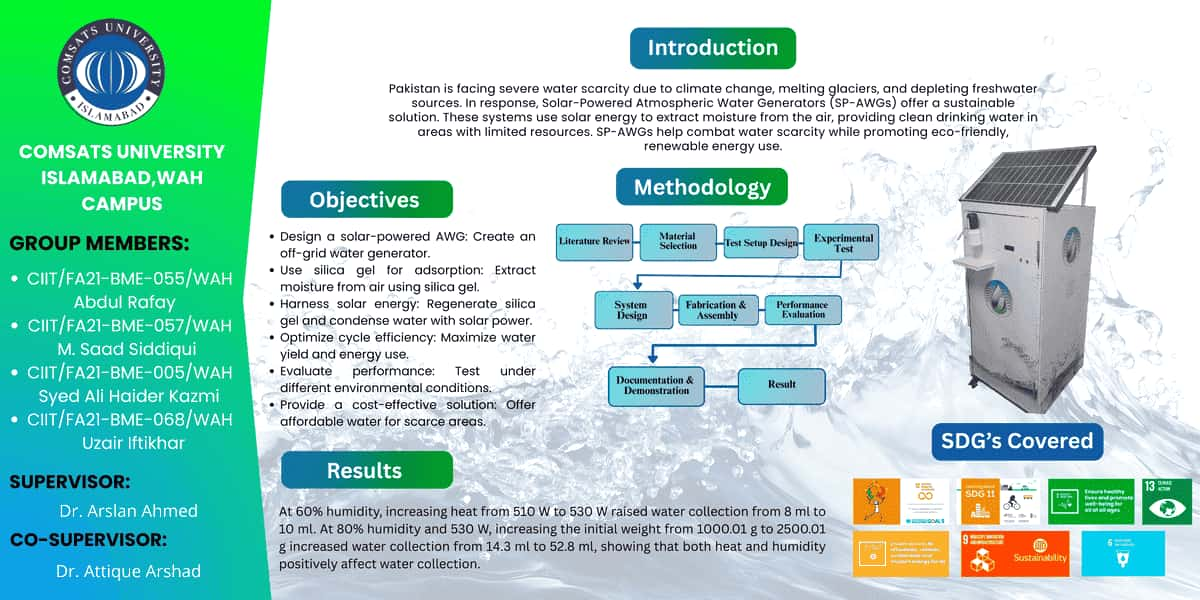
Design and development of Solar-powered Air Water Generator
Currently, Pakistan is facing a serious issue. Climate change and global warming have led to the Earth getting…
Supervisor: Dr. Arsalan Ahmed

DLP based additive manufacturing.
This project investigates composite formulations for Digital Light Processing (DLP)–based additive manufacturi…
Supervisor: Engr. Attique Arshad