Objectives
The overarching objective of this final-year project is to develop and optimize composite photopolymer formulations for Digital Light Processing (DLP)–based additive manufacturing, thereby improving the mechanical performance, dimensional accuracy, and functional applicability of printed components. To achieve this, the project is divided into the following specific objectives:
Benchmark Unmodified Resin Performance
Establish a clear baseline by printing and testing ASTM-standard specimens using a commercial photopolymer resin. Under fixed DLP parameters—layer thickness, exposure time, and light intensity—quantify key metrics including tensile strength, flexural modulus, elongation at break, surface roughness, and feature resolution. This will serve as the reference against which all composite formulations are measured.
Design and Fabricate Composite Resin Blends
Select two reinforcing additives—copper(II) oxide nanoparticles and laser-printed toner powder—based on their proven mechanical enhancement potential and compatibility with photopolymer matrices. Prepare resin blends at incremental weight fractions (1%, 3%, 5%, and 7%) for each additive. Employ magnetic stirring and ultrasonication to ensure uniform dispersion, preventing agglomeration and guaranteeing reproducible curing behavior.
Optimize Photocuring Parameters for Composites
Characterize how additive incorporation alters resin optical absorption and cure kinetics. Using photorheology and optical microscopy, determine the minimum exposure dose and ideal layer thickness required to achieve full crosslinking without over-curing or loss of feature fidelity. Fine-tune projector intensity and resin temperature to maintain consistent polymerization across all composite formulations.
Mechanical Characterization of Composite Specimens
Print standardized tensile, flexural, and impact specimens for each composite formulation under optimized curing conditions. Perform mechanical tests to measure:
Tensile properties: ultimate tensile strength, Young’s modulus, and elongation at break.
Flexural behavior: flexural strength and modulus via three-point bending.
Impact resistance: fracture toughness and energy absorption using Charpy or Izod methods.
Evaluate Fatigue and Durability
Subject selected composite specimens to cyclic loading to determine endurance limits, crack initiation thresholds, and fatigue life. Compare these results to unmodified resin controls to assess improvements in long-term durability for load-bearing applications.
Microstructural and Morphological Analysis
Use scanning electron microscopy (SEM) and energy-dispersive X-ray spectroscopy (EDX) to inspect fracture surfaces, particle-matrix interfaces, and dispersion uniformity. Employ optical and confocal microscopy to evaluate interlayer adhesion, surface defects, and resolution of fine features (<100 µm). Correlate microstructure with mechanical data to understand reinforcement mechanisms.
Socio-Economic Benefit
Local Manufacturing and Supply-Chain Resilience
By enabling on-demand production of high-precision parts, DLP-based additive manufacturing reduces reliance on distant suppliers and long lead times. Small and medium-sized enterprises (SMEs) can fabricate critical components in-house, decreasing inventory costs and vulnerability to global supply-chain disruptions. This localized capability fosters industrial self-sufficiency and encourages the growth of regional manufacturing clusters.
Cost Reduction and Waste Minimization
Traditional subtractive processes often generate significant material scrap; in contrast, DLP printing uses only the resin required to form each layer. Reinforced photopolymer composites further enhance part durability, extending service life and lowering replacement frequency. Together, these factors drive down overall production expenses and waste-management costs, making precision components more affordable for both industry and end consumers.
Job Creation and Skill Development
Adoption of DLP technology creates new roles in digital design, machine operation, post-processing, and quality assurance. Training programs in resin formulation, process optimization, and additive manufacturing maintenance cultivate a skilled workforce, boosting local employment and technical expertise. Universities and vocational institutes can integrate these competencies into engineering and technical curricula, strengthening the talent pipeline.
Accelerated Innovation and Product Customization
Rapid prototyping capabilities shorten design cycles, allowing engineers to iterate quickly and validate concepts before costly tooling investments. This accelerates time-to-market for novel products, particularly in sectors such as medical devices, aerospace, and consumer electronics. Customizable composites also enable patient-specific biomedical implants and bespoke industrial fixtures, enhancing performance and user satisfaction.
Environmental and Resource Efficiency
The layer-by-layer curing approach of DLP minimizes energy consumption compared to energy-intensive machining and molding processes. Reinforced composites that resist wear and fatigue further reduce lifecycle environmental impacts by decreasing the frequency of part replacements. Combined with solvent-efficient post-processing, the technology supports sustainable manufacturing practices and contributes to circular-economy goals.
Economic Competitiveness and Export Potential
Firms that leverage optimized DLP composites can offer high-performance parts at competitive prices, opening opportunities in both domestic and international markets. Pakistan’s emerging manufacturing sector can capitalize on this advanced technology to attract foreign investment, establish export partnerships, and diversify its industrial base beyond traditional textile and commodity exports.
Methodologies
This project follows a structured, four-stage approach—materials preparation, parameter optimization, specimen fabrication, and performance evaluation—to develop reinforced photopolymer formulations for Digital Light Processing (DLP) additive manufacturing.
1. Materials Preparation
A commercial acrylate-based photopolymer resin (405 nm cure) serves as the base. Two fillers—copper(II) oxide (CuO) nanoparticles (~50 nm) and laser-printer toner powder (~10 µm)—are selected for mechanical reinforcement. Each additive is oven-dried at 80 °C for 12 hours to remove moisture. Composite resins are prepared at 0%, 1%, 3%, 5%, and 7% weight fractions: additives are weighed precisely, added to resin under magnetic stirring (500 rpm, 30 min), ultrasonicated (40 kHz, 15 min), then vacuum-degassed (10 mbar, 10 min) to ensure homogeneous dispersion and bubble removal.
2. Photocuring Parameter Optimization
Additive loading alters resin optical absorbance and cure kinetics. For each formulation, UV–Vis spectroscopy measures light attenuation at 405 nm. Single-layer “working-curve” prints (10 mm squares) are exposed across a range of times (2–10 s) at fixed layer thicknesses (25, 50, 75 µm). Cure depths are recorded with a digital micrometer, and Jacobs’ model is applied to extract critical exposure energy (Ec) and penetration depth (Dp). These values inform adjusted exposure times that achieve full crosslinking (cure depth ˜ layer thickness) without overexposure.
3. Specimen Fabrication
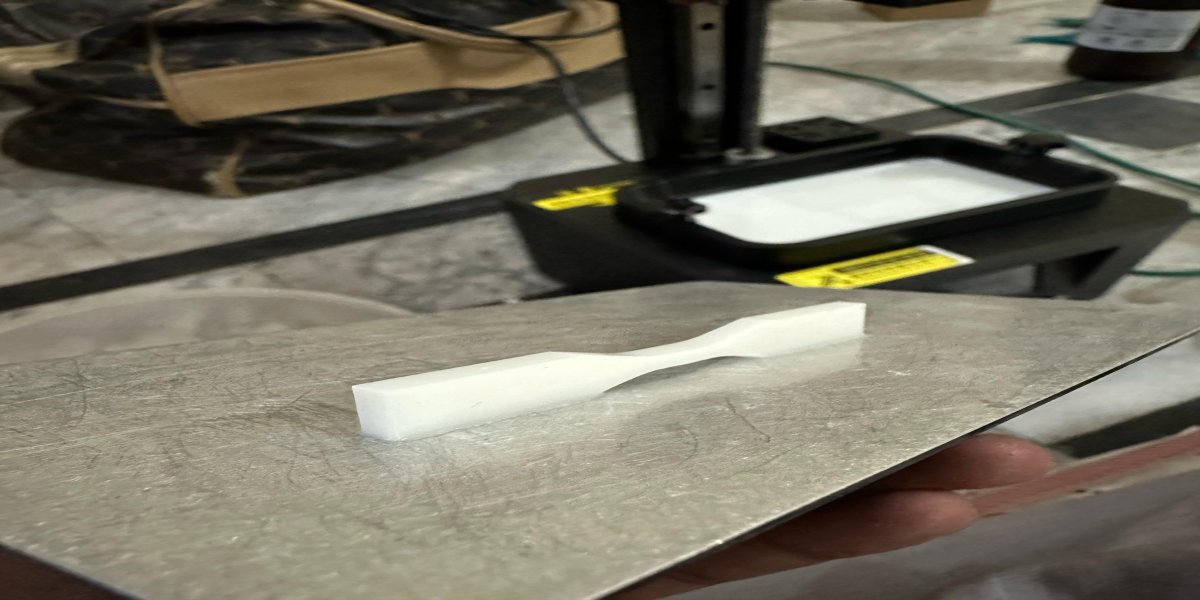
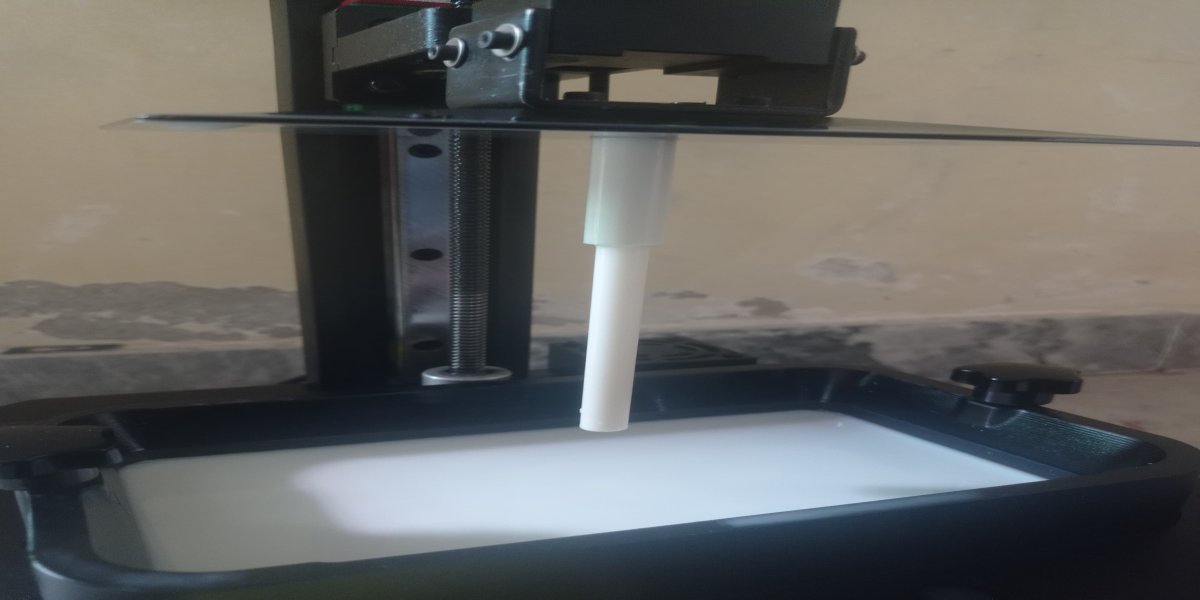
Standard ASTM specimens are printed using optimized parameters: Type V tensile bars (D638), three-point bending beams (D790), and Izod-notched impact samples (D256). Prints are oriented to minimize support structures and batch-processed in triplicate to reduce variability. Post-processing involves ultrasonic washing in isopropyl alcohol (5 min), air-drying (30 min), and UV post-curing (405 nm, 10 min per side). Any specimens showing voids or incomplete cure are discarded and reprinted to ensure three defect-free samples per formulation.
4. Performance Evaluation
Mechanical Testing: Tensile tests (5 mm/min) yield ultimate tensile strength, Young’s modulus, and elongation at break. Flexural tests (span = 50 mm, 2 mm/min) determine flexural strength and modulus. Izod impact tests record energy absorption. Results are averaged over three specimens.
Fatigue Testing: Selected formulations undergo rotating-bending fatigue at stress amplitudes of 50% and 75% of tensile strength, run to failure or up to 10^6 cycles to establish endurance limits.
Microstructural Analysis: Fracture surfaces are examined via scanning electron microscopy (SEM) to assess particle dispersion, interfacial bonding, and fracture modes. Energy-dispersive X-ray spectroscopy (EDX) verifies filler distribution. Optical microscopy inspects layer adhesion and fine-feature resolution.
Outcome
Optimized Composite Formulation
Through systematic variation and testing, the study identified that a 5 wt % CuO nanoparticle–reinforced resin delivered the best balance of mechanical enhancement and printability. Compared to the unmodified resin, this composite exhibited a ~25 % increase in ultimate tensile strength, a 30 % rise in flexural modulus, and maintained over 80 % of the baseline elongation at break.
Refined DLP Processing Parameters
Revised “working curves” for each formulation yielded exposure settings that ensured full cure (cure depth ˜ layer thickness) without feature blurring. For the optimal composite, an exposure time of 6 s per 50 µm layer produced dimensional accuracy within ± 0.15 mm and surface roughness (Ra) under 3 µm.
Robust Predictive Models
Statistical analysis (ANOVA) confirmed that both filler type and weight fraction significantly influence strength and stiffness (p < 0.01). Multiple linear regression models—with R² > 0.92—enable prediction of tensile strength and flexural modulus as functions of additive concentration and exposure time, providing a tool for rapid formulation tuning.
Demonstrated Functional Prototype
A miniature spur-gear assembly printed in the optimized composite ran smoothly under a 0.5 N·m torque, with gear backlash under 0.1 mm and no failure after 1,000 rotations. This validates the material’s suitability for precision, load-bearing applications.
Practical Guidelines and Deliverables
The project delivers:
A recipe for reinforced DLP resin (5 wt % CuO, exposure 6 s/50 µm)
Post-processing protocol (5 min IPA wash, 10 min UV cure per side)
Predictive charts for mechanical properties vs. formulation
Recommendations for industrial and biomedical prototyping