Objectives
Performance Analysis:
Evaluate the turbine's efficiency and power output under various operating conditions, such as different flow rates, water head levels, and rotational speeds.
Design Optimization:
Investigate the impact of different design parameters, such as blade shape, angle, and number, on the turbine's efficiency and power output. Optimize these parameters to maximize performance.
Structural Analysis:
Analyze the structural integrity of the turbine components under different loading conditions, ensuring they can withstand the mechanical forces exerted by the flowing water.
Cost Analysis:
Evaluate the economic feasibility of the Cross Flow turbine by considering factors such as manufacturing, installation, and maintenance costs, as well as the expected power output and potential return on investment.
Flow Characteristics:
Examining the flow patterns and velocity distribution within the turbine, as well as the effects of turbulence and boundary layers. This information helps identify potential flow restrictions, areas of high stress, or regions of low efficiency within the turbine.
Socio-Economic Benefit
Socio-Economic Benefits:
• Hydropower is a renewable source of energy. The energy generated through hydropower relies on the water cycle, which is driven by the sun, making it renewable.
• Hydropower is fueled by water, making it a clean source of energy.
• Hydroelectric power is a domestic source of energy, allowing each state to produce its own energy without being reliant on international fuel sources.
• Hydropower is affordable. Hydropower provides low-cost electricity and durability over time compared to other sources of energy.
• Hydropower creates jobs in rural locations and boosts local economies.
• The construction and operation of hydropower plants can create jobs and stimulate economic development in local communities. In many cases, hydropower projects also support infrastructure development such as road improvements and increased access to electricity.
Methodologies
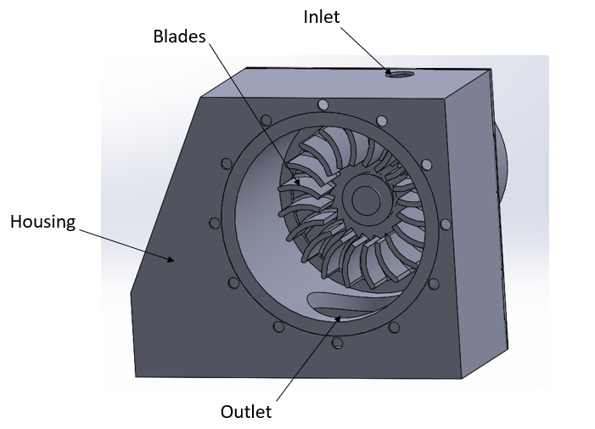
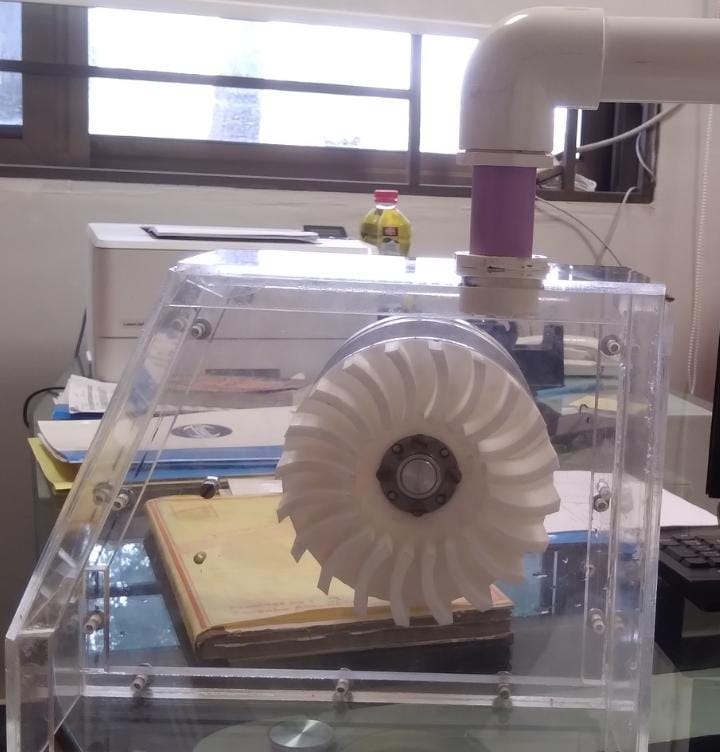
The purpose of the analysis was to study the fluid flow through an impeller using computational fluid dynamics (CFD) simulations. The impeller was designed using Creo 7.0 software, and the blades were 3D printed. The experimental setup was performed using the VDAS Tecquipment MF101 Centrifugal Pump Test Workbench.
Different impeller profiles, including sharp edge, truncated, round, and oval profiles, were considered. The impeller had a diameter of 6 inches, length and width of 1.5 inches, and a thickness of 0.236 inches. It consisted of 20 blades and was fixed to a rotating body with a dimension of 8 inches.
The analysis was conducted using ANSYS CFX-Pre as the flow solver. The geometry and mesh were generated using ANSYS ICEM CFD. A two-dimensional hybrid (unstructured) mesh with a size of 0.0787 inches was generated for the inlet, outlet, and rotating body.
The boundary conditions included a no-slip wall condition for the impeller blades, a subsonic flow regime, and stationary frame type for the inlet and outlet. The rotating frame type was assigned to the blades and rotating body. The inlet boundary had a turbulence zero gradient condition.
Various parameters were considered during the analysis, such as impeller rotational speeds (500, 450, and 550 rpm), number of iterations (400, 450, and 500), turbulence models (K-epsilon and SST K-Omega with high resolutions), inlet pressure of 1 atm, outlet pressure of 0 atm, and a mass flow rate of 2 kg/s. The solver control utilized the equation of continuity and employed the RMS residual type with convergence criteria target of 0.000001.
Overall, the analysis aimed to investigate the fluid flow characteristics through the impeller under different operating conditions. The results obtained from the simulations would provide insights into the performance and efficiency of the impeller design.
Outcome
Analysis of the crossflow turbine provides information on its power generation capability. This includes determining the electrical or mechanical power output of the turbine under different operating conditions. The outcomes may include power curves that illustrate the relationship between flow rate, head, and power output. Also, The result of the analysis can inform design modifications to improve the turbine's performance, efficiency, or operational range. This may involve adjusting the blade shape, optimizing the guide vane design, exploring different materials, or considering innovative solutions to enhance turbine performance. The study of crossflow turbines provides information on flow patterns, velocity distribution, and pressure variations within the turbine. Conclusion may include streamline patterns, and pressure distribution plots. These results help identify areas of flow separation, recirculation, or high turbulence within the turbine, which can impact its performance and efficiency.