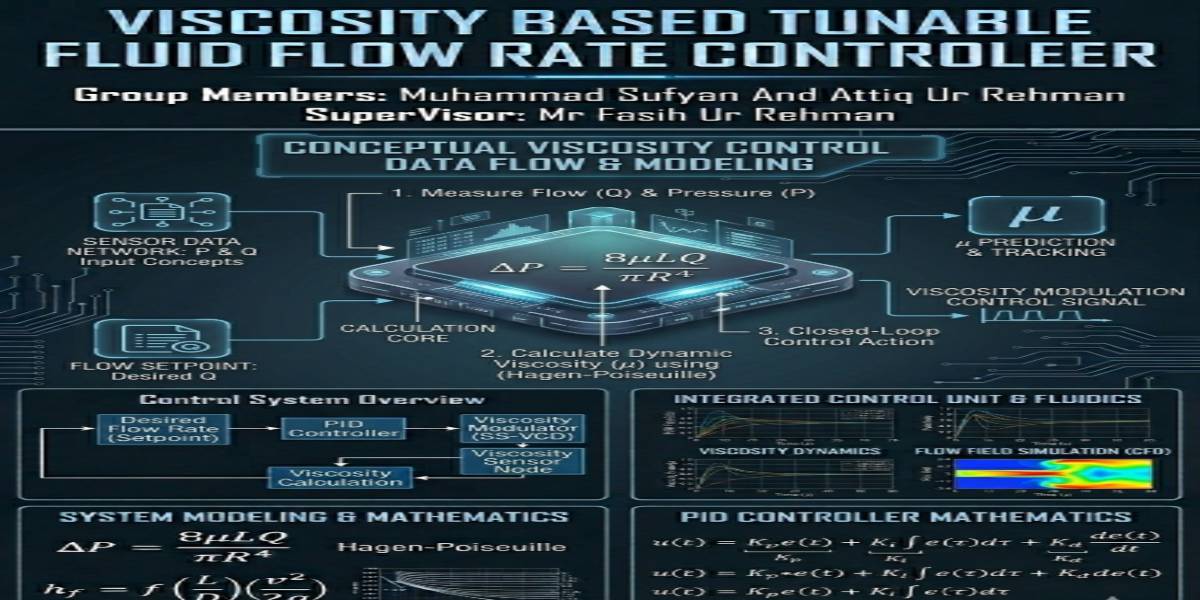
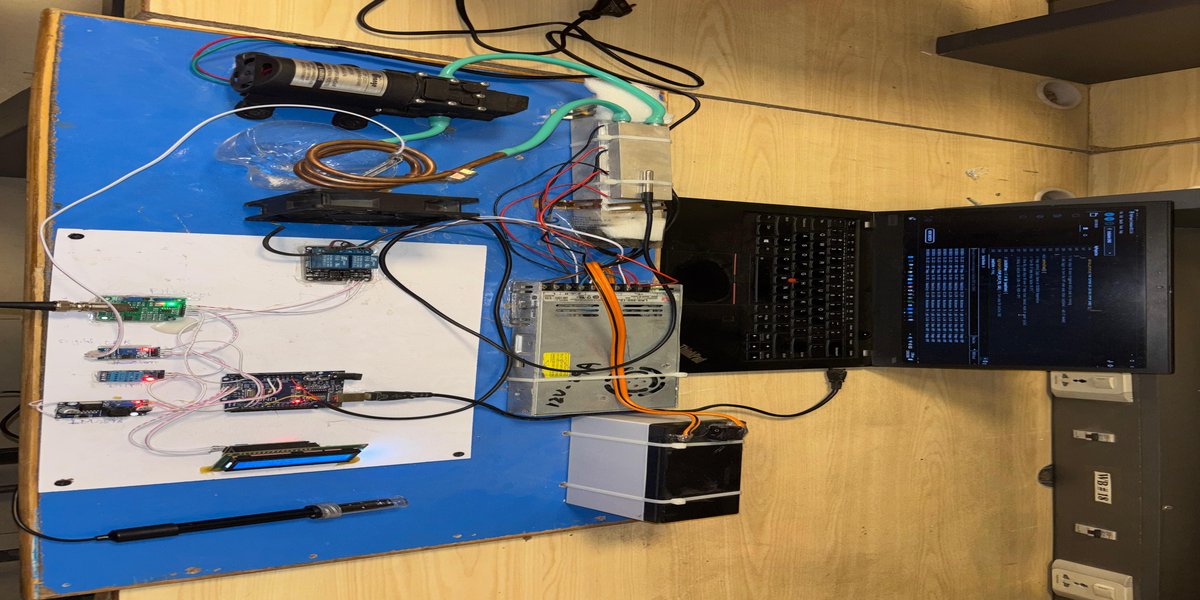
The “Viscosity Based Tunable Fluid Flow Rate Controller using PID” is an intelligent fluid control system designed to regulate and maintain a desired fluid flow rate automatically under varying viscosity conditions. The system uses flow and pressure sensors to monitor fluid characteristics and applies a PID (Proportional–Integral–Derivative) control algorithm to continuously adjust pump speed through an L298N motor driver. This ensures stable and accurate flow control even when the viscosity of the fluid changes due to temperature or composition variations. The project is developed using a microcontroller-based platform with integrated sensors, control circuitry, and real-time monitoring features. The system can be used in industries where precise fluid handling is essential, such as chemical processing, food production, oil industries, and pharmaceutical applications.
Objectives
The main objective of this project is to design and develop an intelligent fluid flow rate controller capable of maintaining a stable and adjustable flow rate for fluids with different viscosities. Traditional flow control systems often fail to provide accurate regulation when fluid properties change, especially viscosity. This project aims to overcome this limitation by implementing a PID-based adaptive control system that continuously monitors pressure and flow conditions and automatically adjusts the pump speed to maintain the desired flow rate.\n\nAnother objective of the project is to improve the efficiency and reliability of industrial fluid handling systems by reducing fluctuations and minimizing manual intervention. The project also focuses on understanding the practical implementation of PID controllers in embedded systems and integrating sensors with microcontrollers for industrial automation applications.\n\nThe system is designed to provide accurate flow rate control, automatic adjustment according to fluid viscosity, stable system response, reduced steady-state error, and real-time monitoring capabilities.
Socio-Economic Benefit
This project offers significant socio-economic benefits in industrial and automation sectors where precise fluid control is required. Industries such as food processing, pharmaceuticals, oil refining, water treatment, and chemical manufacturing depend heavily on controlled fluid transportation systems. By implementing a viscosity-based PID controller, industries can reduce fluid wastage, improve product quality, and enhance operational efficiency.\n\nThe system also helps in minimizing human errors because the control process becomes automated. Accurate flow regulation can reduce energy consumption and maintenance costs of pumps and pipelines. In large-scale industries, this can lead to substantial economic savings.\n\nFrom a social perspective, automation technologies like this project contribute to modern industrial development and create opportunities for engineers and researchers in control systems and embedded technologies. The project also promotes learning and practical understanding of industrial automation among engineering students.
Methodologies
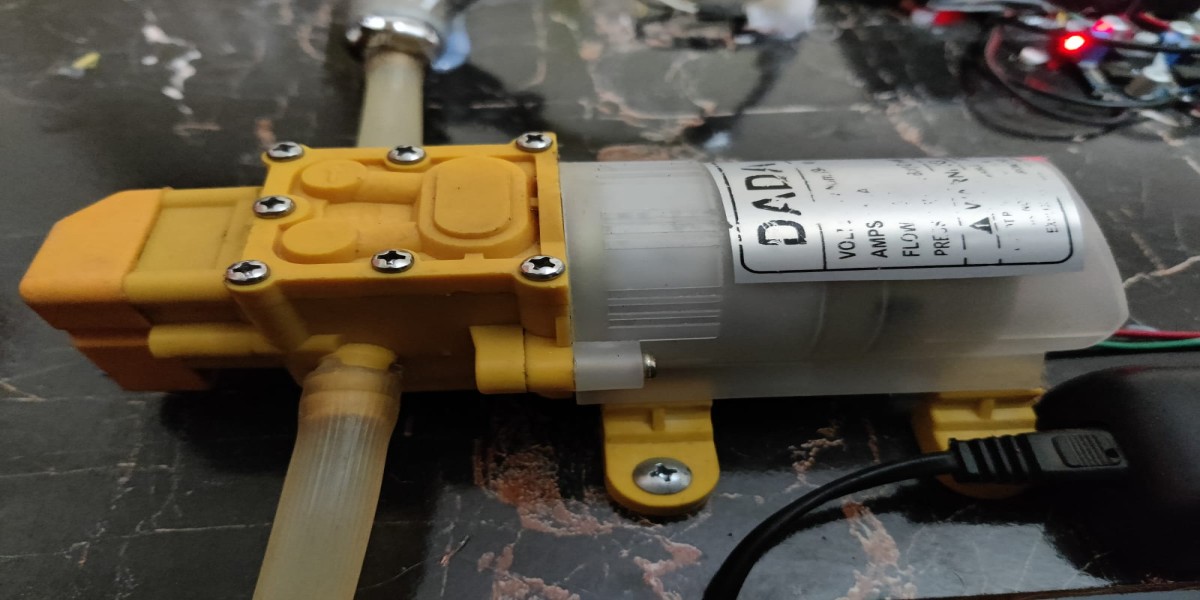
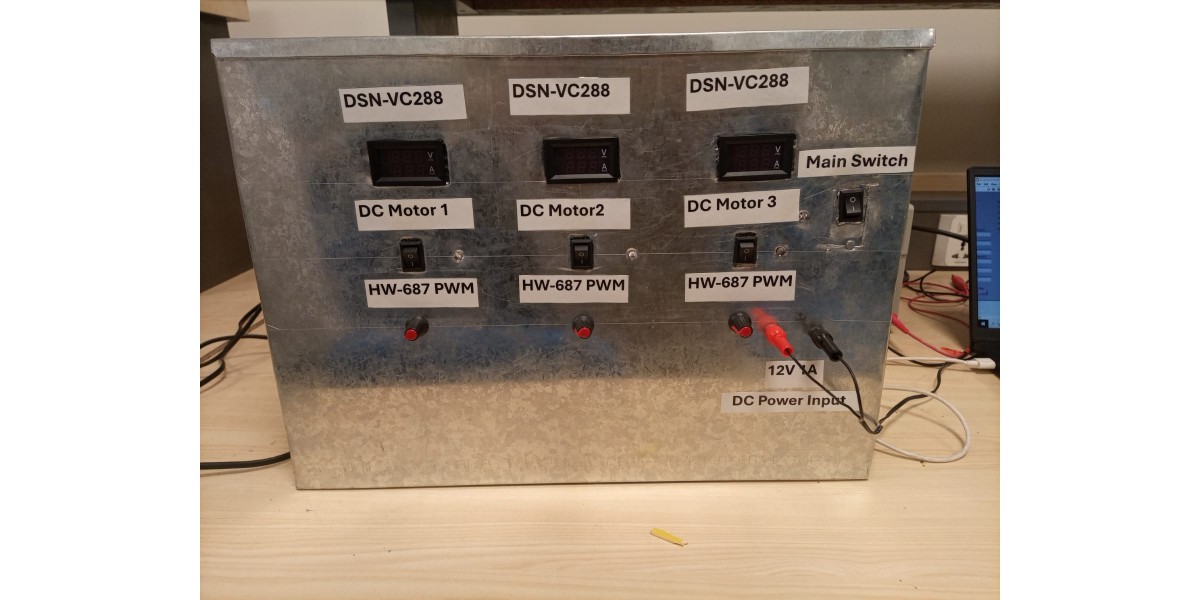
The project follows a systematic methodology involving hardware integration, software programming, sensor calibration, theoretical calculations, and PID-based adaptive control.\n\nInitially, the overall system architecture is designed to include a fluid container, cylindrical tube, flow sensor, differential pressure sensor, DC pump, L298N motor driver, and Arduino microcontroller. The flow sensor continuously measures the fluid flow rate while the pressure sensor measures the pressure drop across the tube.\n\nThe microcontroller uses Hagen–Poiseuille equations to estimate the dynamic viscosity of the fluid in real time. Based on the user-defined target flow rate, the system calculates the required target pressure mathematically.\n\nA PID control algorithm is then implemented to compare the required pressure with the actual pressure. The controller calculates the error and generates a corrective PWM signal. This PWM signal controls the L298N motor driver, which adjusts the speed of the DC pump.\n\nThe entire system is continuously monitored, and PID parameters are tuned to achieve stable response, reduced overshoot, minimal steady-state error, and accurate flow regulation.
Outcome
The successful implementation of this project demonstrates an efficient and intelligent fluid flow control system capable of adapting to varying viscosity conditions. The PID controller provides accurate and stable control over the fluid flow rate, ensuring better system performance compared to conventional fixed-speed pumping methods.\n\nThe project achieves smooth regulation of pump speed and maintains the desired flow rate with reduced fluctuations and fast response time. Experimental and simulation results show that the system can automatically compensate for changes in fluid viscosity and maintain consistent operation with high accuracy.\n\nThe developed prototype provides practical exposure to embedded systems, fluid mechanics, industrial automation, and control engineering concepts. It also highlights the importance of adaptive PID control in modern industrial applications.\n\nThe final system successfully demonstrates stable and tunable fluid flow control, improved accuracy, reduced steady-state error, automatic adaptation to viscosity changes, and real-time monitoring capabilities suitable for industrial environments.